 Cities and countries
 Mythology
 French engraving
 About Us
 Digital copies
Théophile Emmanuel Duverger (1821–1898): Painter and Engraver of Domestic Happiness.
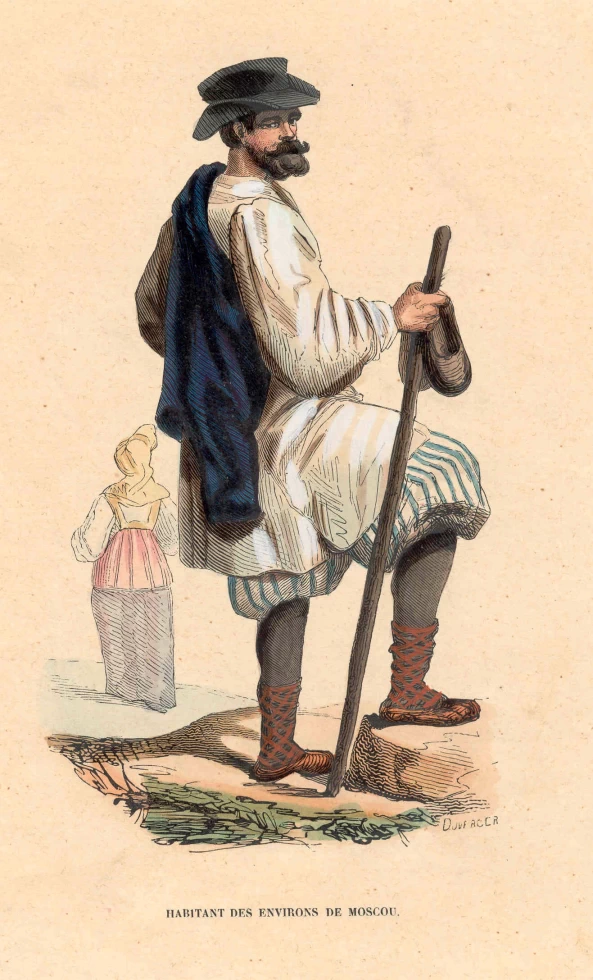
Théophile Emmanuel Duverger (March 17, 1821 – August 25, 1898) was a French painter and engraver, born in Bordeaux and died in Écouen. He was not only a talented artist but also a remarkable printmaker who contributed to famous mid-19th-century publications, including Auguste Wahlen's monumental work "Moeurs, usages et costumes de tous les peuples du monde" (1843–1844), to which your engraving "Habitant des environs de Moscow" belongs.
Remarkably, Duverger was a self-taught painter. He never attended academies but learned by carefully observing nature and studying the works of great masters in museums. The 17th-century Dutch painters, with their attention to everyday life and masterful rendering of textures, particularly influenced him. This independent path allowed his art to develop freely, outside the rigid frameworks of Parisian workshops.
In 1860, Duverger moved to the picturesque village of Écouen, eight miles north of Paris. There, he joined the famous artists' colony founded by Pierre Edouard Frère, associating with painters such as Auguste Schenk, Emile Vernier, and his future son-in-law André-Henri Dargelas. Écouen, with its cozy streets and patriarchal way of life, became the ideal setting for his work.
Duverger created a special world in his paintings and engravings—a world of "domestic utopia" . His works depict scenes of family life: playing children, caring mothers, cozy interiors. He deliberately avoided the gritty reality of some Realist painters, preferring a gentler, more sentimental view of wholesome family life. This is precisely why his works became so beloved by the French bourgeoisie, who sought pleasant, soothing images for their homes.
The American collector William Walters of Baltimore greatly admired his numerous drawings. As one contemporary artist noted, "The village of Ecouen, where we live, is one of the most charmingly picturesque in France. Models, interiors, and interesting subjects are at hand."
Beyond easel painting, Duverger actively worked as a book illustrator and engraver. His contributions to mid-19th-century publications, including Wahlen's famous costume encyclopedia, demonstrate meticulous attention to detail and ethnographic accuracy.
Duverger exhibited regularly at the Paris Salon from 1846 to 1898. His path to recognition was long but successful:
1861 — First award: third-class medal for several works, including "La Gamelle du Grand Papa" (Grandfather's Mess Tin) and "L'Attente" (The Wait)
1863 — Honorable mention
1865 — Second-class medal for "Le Paralytique" (The Paralytic) and "Le Laboreur et Ses Enfants" (The Worker and His Children). The latter was purchased by the State for the Luxembourg Museum and now resides in the collection of the Musée d'Orsay
In 1889, he participated in the Exposition Universelle in Paris, receiving a bronze medal. In 1893, his work was featured at the World's Columbian Exposition in Chicago.
Théophile Duverger's works are held in numerous museums worldwide, including:
Musée d'Orsay (Paris)
Victoria and Albert Museum (London)
The Walters Art Museum (Baltimore)
Musée des Beaux Arts (Bordeaux)
Glasgow Museums and Art Galleries
Guildhall Art Gallery (London)
Sheffield Museum