 Cities and countries
 Mythology
 French engraving
 About Us
 Digital copies
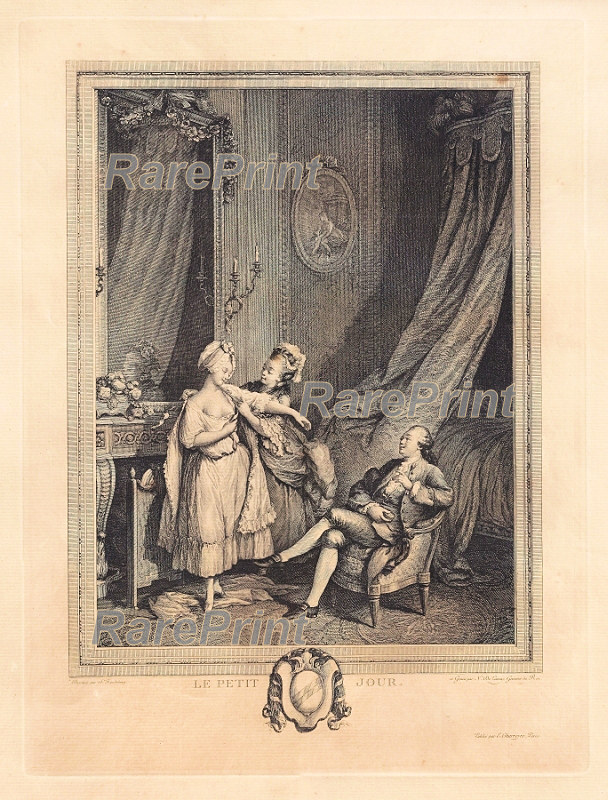
Nicolas de Launay, (1739 - 1792) is a French engraver.
Entered very young in the studio of Louis-Simon Lempereur, Launay made such progress in the art of engraving that he also succeeds in all genres: history, portrait, landscape, vignette A few years later Having been a member of the Copenhagen Academy, he was approved of the Royal Academy of Painting and Sculpture in 1789, and later became engraver of the king. We have several subjects from different masters, portraits and many vignettes. This part of pleasure is quoted mainly by the Weenix, the Good Mother and the Escarpolette, after Fragonard, and finally the First Lesson of Fraternal Friendship, after Aubry. His most important print, in the genre of history, is his March of Silenus after Rubens. As for his books, his vignettes for Ovid's Metamorphoses, the works of Jean-Jacques Rousseau, the Abbé Raynal, after the drawings of Cochin, Moreau, Marillier etc. for the edition of Rousseau, in-4 °, printed in Brussels, the Moliere in-8 ° and Ariosto Baskerville were sought after connoisseurs. In 1772, Cochin made him participate in the project titled Conquest of the Emperor of China. Michaud said of him that "The engravings of this master are generally of a pleasant nature; his chisel, without being dry, is precious; his flesh is soft. He had Jean-Baptiste Fossoyeux, Jean-Baptiste-Michel Dupréel and Ponce as students. He also had a brother, Robert de Launay, engraver like him and his pupil.