Cities and countries
 Mythology
 Russian Engravers
 About Us
 Digital copies
August Ivanovich Daugell (German: August Johann Daugell; January 1, 1830, Tartu — November 8, 1899, St. Petersburg) was an Estonian and Russian engraver, one of the leading masters of wood engraving (xylography) in the second half of the 19th century.
He was born in Tartu to the family of Johann Daugull, founder of the famous "Daugulli aiaäri" garden nursery . He received his initial artistic education in Tartu under Friedrich Ludwig von Maydell, a renowned Baltic German graphic artist . One of his first works was illustrations for Friedrich Kreutzwald's "Reynard the Fox" (1848) . He later continued his studies as a non-degree student at the Imperial Academy of Arts in St. Petersburg.
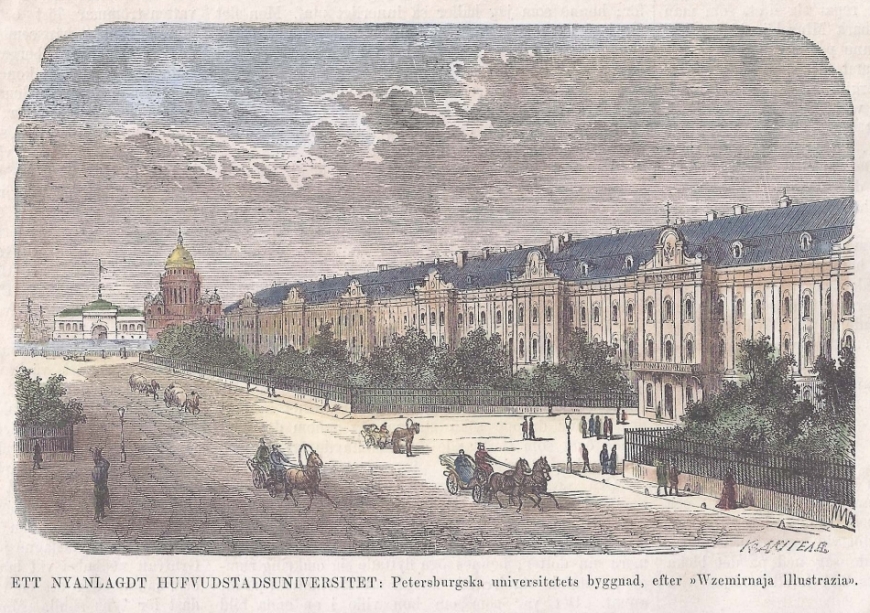
In the 1860s, Daugell opened his own xylographic workshop in St. Petersburg, which became one of the leading establishments in the capital. His engravings were regularly published in Russia's most popular illustrated magazines—"Vsemirnaya Illustratsiya" (World Illustrated), to which your engraving belongs, "Niva," and other publications. It was in Daugell's workshop that the illustrations seen by all of reading Russia were created.
The subject matter of his work was extremely diverse: from cityscapes and architectural views to historical scenes and portraits. The Art Museum of Estonia's collections preserve his works, including illustrations for "Vsemirnaya Illustratsiya" from 1870 depicting events of the Franco-Prussian War and urban scenes . Views of St. Petersburg hold a special place in his oeuvre, accurately and lovingly capturing the appearance of the Northern capital in the 19th century. He also created illustrations for Estonian publications, including the "Ma-rahwa Kalender" calendars and catalogs for his family's garden nursery.
Daugell trained an entire generation of engravers. Among his students was Eduard Magnus Jakobson, the founder of Estonian national graphic art.
Despite working in St. Petersburg, Daugell maintained ties with his homeland throughout his life and died in 1899 in St. Petersburg, leaving a rich graphic legacy now preserved in museums in Estonia and Russia.

old prints & graphics