 Cities and countries
 Mythology
 Reproductions of paintings
 About Us
 Digital copies
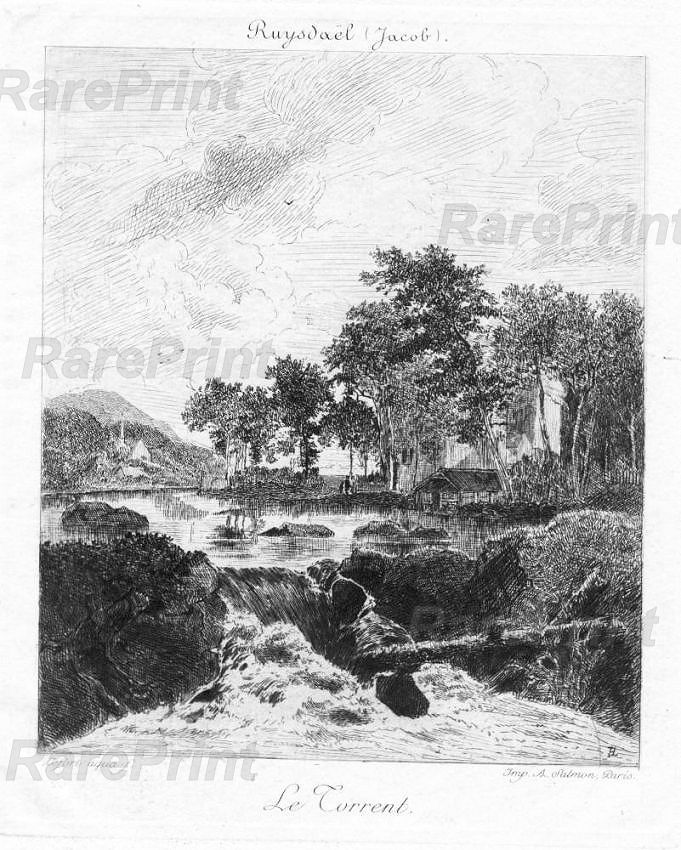
Jacob Isaackszoon van Ruisdael (1629 – 1682) was a Dutch painter, draughtsman, and etcher. He is generally considered the pre-eminent landscape painter of the Dutch Golden Age, a period of great wealth and cultural achievement when Dutch painting became highly popular.
Ruisdael's work from c. 1646 to the early 1650s, when he was living in Haarlem, is characterised by simple motifs and careful and laborious study of nature: dunes, woods, and atmospheric effects. By applying heavier paint than his predecessors, Ruisdael gave his foliage a rich quality, conveying a sense of sap flowing through branches and leaves.His accurate rendering of trees was unprecedented at the time: the genera of his trees are the first to be unequivocally recognisable by modern-day botanists. His early sketches introduce motifs that would return in all his work: a sense of spaciousness and luminosity, and an airy atmosphere achieved through pointillist-like touches of chalk. Most of his thirty black chalk sketches that survive date from this period.
An exemplar of Ruisdael's early style is Dune Landscape, one of the earliest works, dated 1646. It breaks with the classic Dutch tradition of depicting broad views of dunes that include houses and trees flanked by distant vistas. Instead, Ruisdael places tree-covered dunes prominently at centre stage, with a cloudscape concentrating strong light on a sandy path. The resulting heroic effect is enhanced by the large size of the canvas, "so unexpected in the work of an inexperienced painter" according to Irina Sokolova, curator at the Hermitage Museum. The art historian Hofstede de Groot said of Dune Landscape: "It is hardly credible that it should be the work of a boy of seventeen".